Secant Pile Wall Construction Using EPS Geofoam
Secant pile wall construction is used for deep excavation support, earth retention, and projects where limited space, groundwater, or nearby structures make conventional foundation and shoring methods difficult. The system is formed from overlapping drilled concrete piles that create a continuous wall.
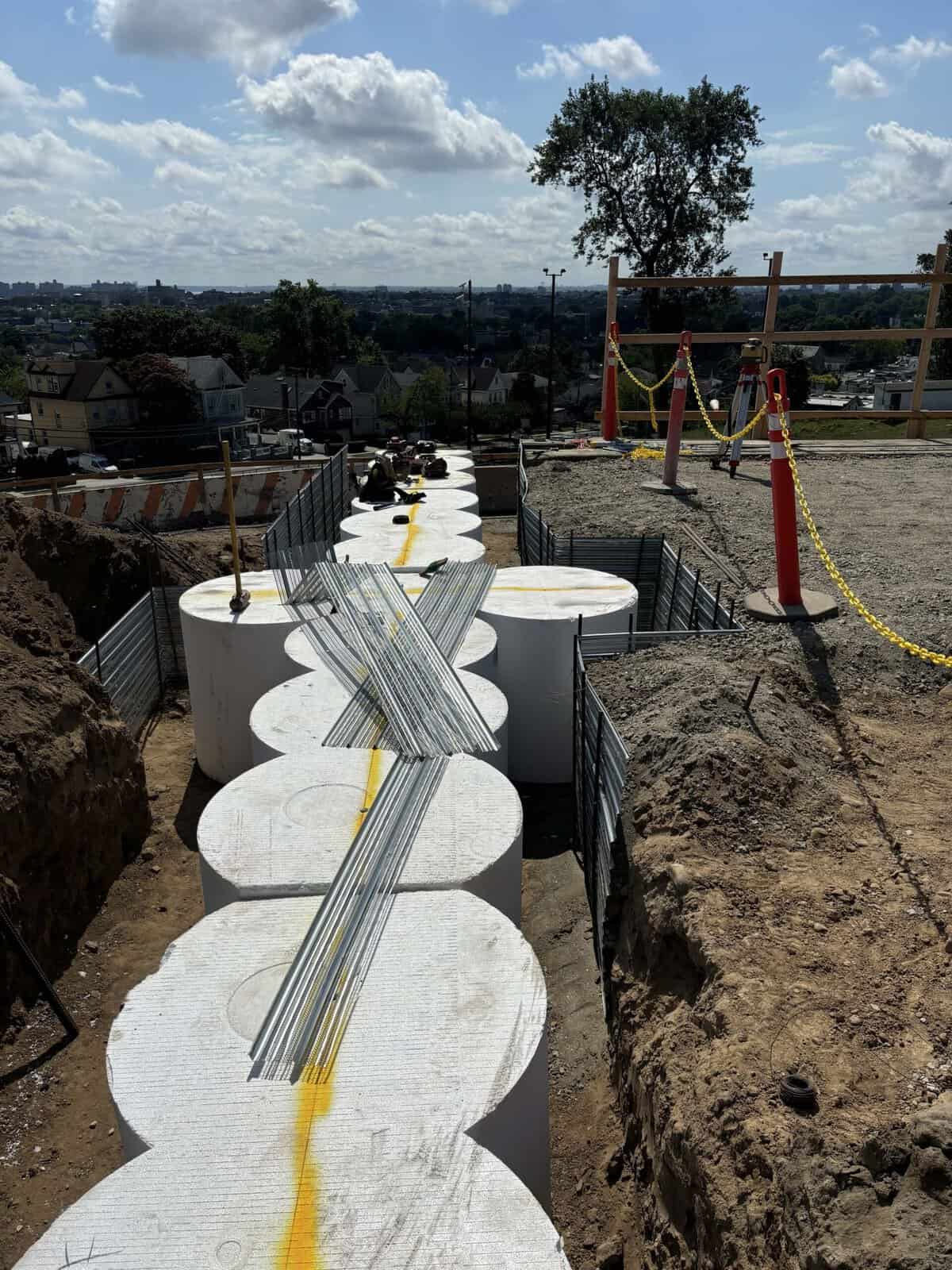
EPS, or Expanded Polystyrene, can be incorporated into this construction process as a fabricated sacrificial form or block out. Rather than serving as the structural pile itself, the EPS component is manufactured to establish the required pile geometry, spacing, and overlap before and during the drilling and concrete placement process.
For projects involving tight property lines, underground structures, pump stations, transportation infrastructure, foundations, or deep excavations, custom EPS secant pile forms can provide a lightweight way to create project specific geometry while simplifying handling and layout.
What Is Secant Pile Wall Construction?
A secant pile wall is a retaining or foundation system made from overlapping drilled shafts or concrete piles. Unlike a tangent pile wall, where piles are constructed adjacent to each other, secant piles intentionally overlap so that the completed wall forms a continuous interlocking line.
FHWA describes secant pile systems as overlapping drilled shafts that can be used for earth retaining structures. In a typical arrangement, one series of piles is constructed first, followed by the intervening piles, which are drilled with an overlap into the previously constructed shafts. Reinforcement can then be incorporated into the structural piles as required by the project design.
The amount of overlap, pile diameter, center to center spacing, reinforcement, concrete specifications, drilling method, and construction sequence are project specific. These parameters are established by the project’s geotechnical and structural design rather than by the EPS form manufacturer.
Secant pile walls can be particularly useful where excavation must occur close to existing buildings, property lines, utilities, roadways, or other infrastructure. They can also be designed for applications where groundwater control and reduced disturbance are important considerations. FHWA notes that secant pile walls can function as retaining systems and that their overlapping configuration can provide a more continuous wall than tangent pile construction.
 What Are EPS Sacrificial Forms?
 What Are EPS Sacrificial Forms?
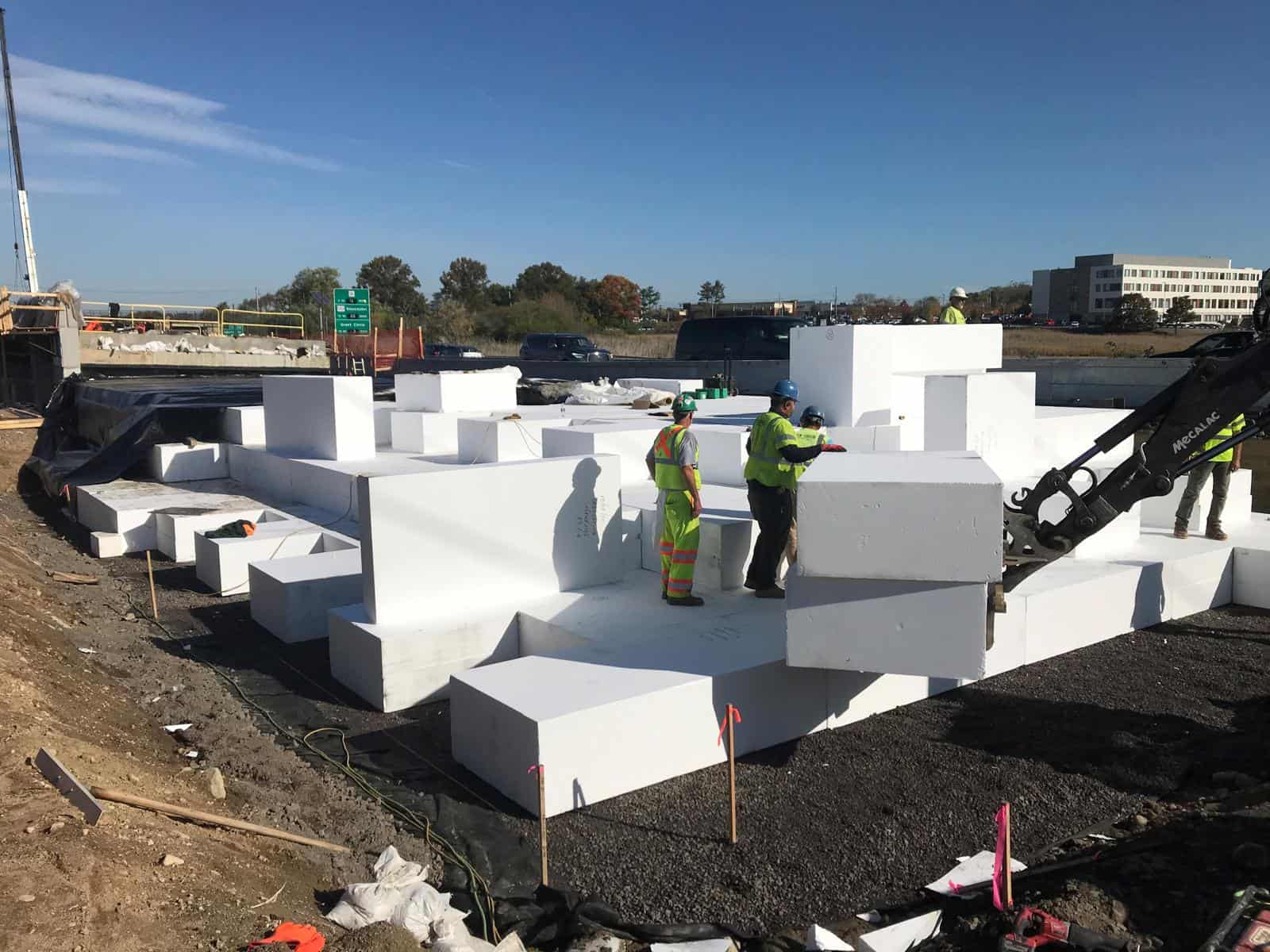
EPS stands for Expanded Polystyrene, a cellular polymer material manufactured by expanding polystyrene beads. EPS is widely used in construction as insulation and as Geofoam for lightweight fill applications.
EPS Geofoam is specified under ASTM D6817/D6817M, which covers the physical properties and dimensions of rigid cellular polystyrene Geofoam. The current ASTM specification addresses properties including density, compressive resistance, flexural strength, dimensions, and other performance requirements. ASTM also maintains D7180/D7180M as a guide for the use of EPS Geofoam in geotechnical projects.
For secant pile work, EPS can be fabricated into shapes that serve as guide forms, blockouts, or temporary forming elements. The terminology can vary from project to project, but the function is similar: the EPS component establishes a specific geometry that helps the contractor create the intended pile arrangement.
The term “sacrificial” refers to the fact that the form is not necessarily intended to be recovered and reused as conventional panel formwork. Depending on the construction method and project requirements, the EPS may be removed, drilled through, or otherwise consumed during the subsequent construction process.
This is different from using EPS as a conventional void fill product. In a secant pile application, the EPS is being fabricated for a specific forming purpose and coordinated with the pile geometry.
How EPS Forms Are Used in Secant Pile Construction
The exact procedure depends on the drilling equipment, secant wall design, soil conditions, reinforcement requirements, and project specifications. The general process can be understood in several stages.
1. Establish the pile layout
The contractor and project design team establish the centerline of the secant pile wall and determine the required pile diameter, center to center spacing, overlap, depth, and sequence.
Because secant piles rely on intentional overlap, dimensional accuracy is important. A small change in pile spacing or diameter can affect the amount of overlap available between adjacent piles.
2. Fabricate the EPS forms
The required geometry is translated into an EPS form or group of forms.
Depending on the application, a form may represent a single cylindrical geometry or incorporate multiple overlapping shapes into one fabricated component. The exact configuration depends on the drilling process and the layout specified for the project.
EPS can be cut and fabricated into custom dimensions, making it suitable for projects where standard formwork does not match the required geometry.
3. Install or position the forming system
The EPS components are positioned in accordance with the project layout and construction method.
A guide wall or other positioning system may also be used to establish the reference line for the secant pile wall. FHWA and transportation specifications recognize the importance of controlling pile location and alignment during drilled shaft and secant pile construction.
4. Construct the piles
Drilling equipment is then used to create the pile shafts. Depending on the specified system, casing, drilling fluids, or other means may be used to support the excavation.
Primary and secondary pile construction is sequenced so the secondary pile intersects the previously constructed primary pile. The resulting overlap creates the characteristic secant configuration.
5. Incorporate reinforcement and concrete
The structural pile is completed in accordance with the project documents. Reinforcing cages, steel sections, concrete strength, concrete placement procedures, and other structural requirements are determined by the project engineer and contractor.
The EPS form does not replace these structural components. Its purpose is to help establish or maintain the required geometry during construction.
6. Remove or drill through the EPS
Depending on the approved construction method, the EPS may be removed before drilling or may be drilled through as part of the pile construction process.
This distinction should be established before fabrication because it affects the required EPS geometry, density, dimensions, and installation approach.
Why EPS Is Used as a Sacrificial Form
EPS offers several characteristics that can be useful when a project requires custom forming or blockout geometry.
Lightweight handling
One of the most obvious advantages is weight. EPS Geofoam is significantly lighter than conventional materials such as concrete, steel, and many wood based forming components. The low density of EPS also makes large fabricated components easier to move and position compared with similarly sized rigid materials.
For construction sites with restricted access or limited staging space, this can simplify material handling.
Custom fabrication
EPS can be cut into custom shapes and dimensions to match project drawings. This is especially relevant when a secant pile wall contains unusual geometry, varying pile configurations, or specialized openings.
The ability to fabricate the form before delivery can reduce the amount of field modification required.
Multiple pile configurations
A secant wall may require a repeated arrangement of overlapping circles or more complicated configurations around corners, structures, or openings.
EPS forms can be manufactured around the geometry established by the project drawings rather than forcing the design to conform to a standard off the shelf form.
Blockout capability
EPS blockouts can be used where a project requires a specific void or opening to be maintained through a concrete operation.
The same basic concept is used throughout concrete construction, where EPS is commonly fabricated into blockouts and forming components because it can be shaped to the required geometry. ASTM recognizes EPS as a rigid cellular polystyrene material with defined physical properties, while project specific forming performance must still be evaluated for the intended application.
Potential reduction in form removal
Traditional reusable form systems must generally be installed, supported, stripped, cleaned, and removed.
A sacrificial or blockout approach can eliminate some of those handling steps when the project design permits the form to remain temporarily in place or be consumed during subsequent work.
The actual labor impact depends heavily on the construction method, site conditions, form geometry, drilling equipment, and contractor installation procedure. It should therefore be evaluated on a project specific basis rather than assumed.
EPS Geofoam and Structural Properties
Not every EPS product has the same density or compressive resistance.
ASTM D6817 classifies EPS Geofoam by material type and physical properties. Poly Molding’s published Geofoam data, for example, includes grades ranging from EPS12 through EPS46, with increasing density and compressive resistance as the grade increases.
For example, Poly Molding’s published EPS15 data lists a minimum density of 0.90 lb/ft³ and a minimum compressive resistance of 3.6 psi at 1 percent deformation. Higher grades provide greater compressive resistance.
Those values should not be interpreted as a recommendation that a particular EPS grade is appropriate for every secant pile application.
For a fabricated EPS secant form, the correct material selection may depend on the loads imposed on the form during handling, placement, drilling, concrete operations, and any other stage identified by the contractor or engineer.
The distinction between EPS Geofoam and EPS insulation is also important. ASTM C578 covers rigid cellular polystyrene products intended for thermal insulation, while ASTM D6817 addresses rigid cellular polystyrene Geofoam. The applicable specification should be selected based on the actual intended use and project requirements.
EPS Sacrificial Forms vs. Conventional Forming Methods
- EPS secant pile forms are not a universal replacement for steel, wood, concrete, or other forming systems. The appropriate solution depends on the project.
- EPS may offer advantages where the project requires:
- Lightweight components that can be manually handled or moved with relatively little equipment.
- Custom dimensions that would be difficult or expensive to fabricate using conventional materials.
- Repeated or complex overlapping pile geometries.
- Forms that can be removed, drilled through, or otherwise consumed during construction.
- Reduced field modification compared with fabricating an unusual shape on site.
- Conventional materials may remain preferable where forms must be reused repeatedly, where unusually high forming loads are expected, or where the contractor’s construction method is already optimized around conventional systems.
- The decision should consider fabrication, transportation, site access, installation, removal, equipment, labor, project repetition, and the specific engineering requirements.
Applications for EPS Secant Pile Forms
EPS secant pile forms may be considered for a range of underground and foundation construction applications, including:
Pump stations
Pump stations and wet well structures can involve deep excavations, groundwater considerations, and restricted working areas. Custom EPS forms can be used where pile geometry requires specialized forming components.
Underground structures
Basements, utility structures, shafts, and other below grade construction can require retaining systems that fit within tight footprints.
Transportation infrastructure
Roads, tunnels, bridge related construction, and other infrastructure projects may require deep excavation support close to existing facilities and transportation corridors. FHWA identifies bored and secant pile systems among earth retention technologies used in transportation construction.
Foundations and deep excavation
Secant pile walls can serve as excavation support and can also be integrated into broader foundation systems depending on project design.
Specialized openings and pile configurations
Where a project includes unusual geometry, EPS can provide a practical way to fabricate project specific forms and blockouts rather than relying solely on standard forming components.
Designing EPS Forms for Secant Pile Projects
The most useful starting point for an EPS secant pile form quotation is a project drawing or a detailed geometry package.
Important information can include:
Pile diameter
The nominal pile diameter establishes the base geometry of the form.
Center to center spacing
Spacing determines how individual pile locations relate to one another and is fundamental to establishing the intended overlap.
Required overlap
The overlap between adjacent piles should be taken from the approved project design rather than estimated by the form manufacturer.
Wall geometry
Straight runs, corners, transitions, changes in pile diameter, and unusual conditions may require different form configurations.
Required depth
The overall form dimensions and fabrication method depend on the required depth and how the EPS will interact with the drilling operation.
Form dimensions and quantities
The manufacturer needs the required number of forms, dimensions, sequence, and any labeling or identification requirements.
Drawings and specifications
Approved plans, details, shop drawings, specifications, and project notes are valuable because they provide the information needed to coordinate the fabricated EPS components with the construction system.
Site and construction conditions
Access, handling limitations, drilling equipment, environmental requirements, groundwater conditions, and the planned method of removing or drilling through the EPS may affect the final form design.
For this reason, the final EPS form should be coordinated among the engineer, contractor, drilling subcontractor, and EPS manufacturer. ASTM D7180 specifically emphasizes that EPS Geofoam selection and geotechnical application require appropriate engineering judgment and project specific consideration.
Why Work With Poly Molding for EPS Secant Pile Forms?
Poly Molding manufactures EPS Geofoam and custom EPS products from its facility in Haskell, New Jersey. The company’s existing secant forms program is focused specifically on fabricated EPS forms for secant pile applications.
For a secant pile project, the value of the manufacturer is not simply supplying raw EPS material. The form needs to correspond with the pile geometry and the construction method being used on the project.
Poly Molding can work from project drawings and application requirements to develop fabricated EPS components for specialized construction applications. Its published Geofoam documentation also provides material data for multiple EPS grades, allowing project teams to review physical properties when selecting a material for a particular application.
Project teams considering EPS secant pile forms should provide drawings whenever possible, along with pile diameter, spacing, overlap, depth, quantities, and any available construction details.
The earlier these requirements are coordinated, the easier it is to determine the appropriate EPS configuration, material grade, fabrication requirements, and delivery schedule.
Frequently Asked Questions About EPS Secant Pile Forms
What is an EPS secant pile form?
An EPS secant pile form is a fabricated Expanded Polystyrene component used to establish or maintain the geometry required for a secant pile construction system. It functions as a forming or blockout component rather than as the structural concrete pile.
What is a sacrificial form?
A sacrificial form is a forming component that is not intended to be recovered for repeated use. Depending on the construction method, it may remain temporarily in place, be removed before the next operation, or be drilled through or consumed during construction.
Can EPS be used in secant pile wall construction?
Yes. EPS can be fabricated for use as a guide form or blockout in secant pile construction. The exact configuration depends on the pile diameter, spacing, overlap, depth, drilling method, and project requirements. The structural secant wall itself remains a concrete and reinforcement system designed by the project’s engineering team.
What type of EPS is used for sacrificial forms?
The appropriate EPS grade depends on the loads and handling conditions the form will experience. EPS Geofoam is available in multiple densities and compressive resistance levels, so material selection should be based on the project requirements rather than a single standard grade.
What information is needed to manufacture an EPS secant pile form?
The most useful information includes pile diameter, pile spacing, overlap, wall geometry, depth, quantity, drawings, specifications, and details about the planned construction and drilling process.
Can EPS forms be custom fabricated?
Yes. EPS can be fabricated into custom shapes and dimensions. Custom fabrication is particularly useful when the secant pile geometry includes unusual configurations, transitions, corners, or other project specific requirements.
What is the difference between EPS Geofoam and conventional EPS insulation?
Both are based on expanded polystyrene, but they are governed by different specifications and intended applications. ASTM C578 covers cellular polystyrene thermal insulation, while ASTM D6817 covers rigid cellular polystyrene Geofoam. Material selection should match the project’s actual design and performance requirements.
How are EPS forms incorporated into concrete construction?
The EPS form is positioned according to the project layout and construction method, after which concrete and reinforcement are installed as specified. Depending on the application, the EPS may be removed or drilled through during subsequent construction.
Conclusion
EPS sacrificial forms provide another way to approach the specialized geometry associated with secant pile wall construction. Their low weight, custom fabrication capability, and ability to create defined shapes and block outs can make EPS useful where conventional forming methods are difficult to handle or customize.
The key is proper coordination. Pile diameter, spacing, overlap, depth, wall geometry, material requirements, and construction sequence should all be established before fabrication.
For engineers, contractors, foundation specialists, and underground construction professionals, a project drawing is the best starting point for determining whether an EPS secant pile form is appropriate and what configuration is required.
Poly Molding manufactures EPS Geofoam and custom EPS components for specialized construction applications. For a project specific evaluation or quotation, provide the project drawings and secant pile geometry so the required form configuration can be reviewed.
For additional information please go to Secant Forms with Geofoam for Pile Walls | Poly Molding LLC